

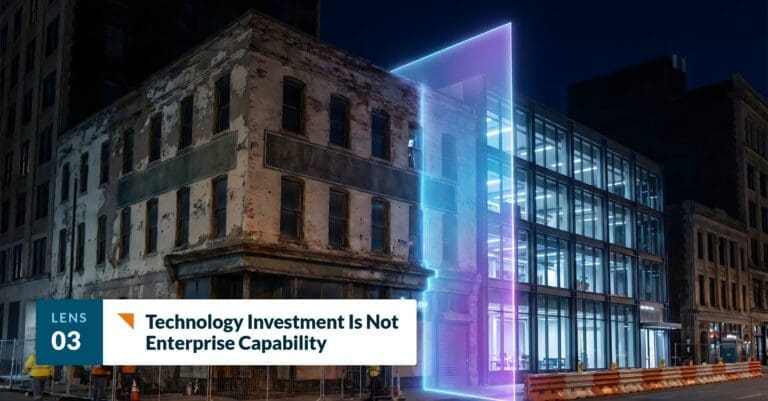
Cloud migration changes where a workload runs; modernization changes how quickly and safely the business can change it. Executives should fund modernization against a measurable business constraint, such as change lead time or release risk, not migration percentage.
Dana, the chief product officer, was told that the company’s most important customer platform had been migrated successfully. The infrastructure report was complete. Yet a modest pricing change still required several teams, a long approval chain, and a release window that carried more risk than the change deserved.
The workload had moved. The business hadn’t become easier to change.
This scenario is fictional. The pattern is not.
The C-suite decision on modernization
For a CEO, the question isn’t whether a workload should be rehosted, refactored, or re-architected. It’s what business constraint the investment will remove, how much improvement is expected, what it will cost, and what risk remains if the organization does nothing. CIOs and CTOs should turn the technical choices into those business tradeoffs before asking the broader C-suite to fund them.
Modernization is the ability to change with less delay and risk
The business cost of a slow technology estate isn’t abstract technical debt. It’s the delayed product decision, the customer experience that cannot be changed in time, the regulatory response that becomes a fire drill, and the high-risk release created when too many systems and teams must move together.
A workload can be running in the cloud while those costs remain. The location changed; the enterprise’s ability to change didn’t.
That’s the distinction executives need to protect in every cloud program: migration changes where a workload runs. Modernization changes how the business can evolve it.
What is the difference between cloud migration and modernization?
Migration can be strategically necessary. It may address an expiring hosting commitment, unsupported infrastructure, resilience needs, or a desire to establish a new foundation. Moving a workload without changing its application architecture can be a disciplined way to reduce immediate risk or meet a deadline.
Microsoft’s Cloud Adoption Framework lists migration and modernization as distinct activities: moving workloads to Azure is one activity; improving existing workloads to better meet business needs is another. AWS likewise distinguishes moving a workload with little or no application change from re-platforming or changing its architecture.
The executive mistake isn’t choosing to rehost. The mistake is treating the migration strategy as proof that the business now has a modern capability.
Modernization is complete only when leaders can show that the capability is easier to change, safer to operate, and less dependent on avoidable coordination. The right path will vary by business value, risk, remaining life, and change demand.
How should executives measure modernization?
Executives should ask what the enterprise must spend, in time, coordination, risk, and operating effort, to make a meaningful change. This cost of change is the better measure of modernization.
How long does it take to move from an approved business decision to a production change? How many teams must coordinate? Can the change be released independently? Can the organization access the data required to make or automate a decision with appropriate confidence? Are security, quality, and compliance controls embedded in the flow, or do they arrive as late manual gates?
These questions make modernization visible. A migration percentage can describe location. But it cannot, by itself, describe adaptability.
Migration can preserve the old cost of change
Relocation doesn’t remove tight coupling, undocumented interfaces, duplicated data, manual testing, or knowledge concentrated in a few people. If those conditions made change expensive before migration, they can continue to make it expensive afterward.
That doesn’t make migration a failure. It just makes the decision incomplete.
The executive team should make the portfolio choices explicit: which capabilities should be retired, retained, rehosted, re-platformed, refactored, or re-architected, and why. AWS groups these options, along with relocate and repurchase, as its “7 Rs” of migration strategy. The CEO doesn’t need to arbitrate the engineering method. The CIO and CTO should translate those options into business value, cost, risk, remaining life, and expected improvement in the ability to change.
Architecture is experienced as coordination
Architecture has an executive consequence: it determines how much organizational effort a change requires.
When a customer or employee journey crosses too many opaque boundaries, the business experiences architecture as delay. When data must be copied and reconciled before a decision can be made, it experiences architecture as uncertainty. When every release requires a large integrated event, it experiences architecture as concentrated risk.
Modern architecture doesn’t mean eliminating every dependency. It means making important dependencies visible, owned, and manageable. Boundaries, reliable interfaces, shared capabilities, and visibility into system behavior matter because they can reduce the coordination required to change, not because they’re fashionable patterns.
This is also why the proof-of-concept-to-production gap and the black-box problem in distributed systems are leadership concerns. They expose whether an idea can become an operated, accountable business capability.
Modernization changes the operating model
Modern technology still produces slow change when ownership, funding, decision rights, and controls remain organized around periodic projects and handoffs. When that happens, the constraint is an operating-model gap, not a technology gap.
Executives should look for durable ownership of business capabilities, decision rights close enough to the work to avoid needless delay, controls that are automated where appropriate, and measures that connect delivery performance to business outcomes. DORA’s research describes a Core Model built from recurring research findings and emphasizes capabilities and outcomes in a broader sociotechnical system; that’s a more useful frame than treating a cloud platform as the outcome.
The question isn’t whether every team should work the same way. It’s whether the operating model makes accountability and change friction explicit.
New business demands expose unfinished modernization
AI is one highly visible example, but the same test appears whenever the business needs to launch a new digital product, respond to regulation, integrate an acquisition, change pricing, or automate a process. These demands require current data, clear interfaces, reliable controls, observability, and accountable ownership. Fragmented foundations can support a demo while still making the capability difficult to operate safely or repeatably.
That isn’t an argument for postponing AI until every legacy system is rebuilt. AI initiatives can help expose the data, governance, ownership, and technology constraints that may otherwise slow the organization down. The production-grade AI operations and AI leadership playbook provide related governance context.
An executive modernization outcome scorecard
For a CEO, the scorecard isn’t a technical assessment. It’s evidence that the investment is reducing a business constraint. CIOs and CTOs can use the measures below to translate architecture and engineering work into outcomes the broader C-suite can evaluate.
| Dimension | Executive question | Evidence to request |
|---|---|---|
| 01Change lead time | How long from an approved business decision to a production change? | Trend by critical capability and change type. |
| 02Deployment independence | Can a team release without a large coordinated event? | Release dependencies, rollback readiness, and approval cycle. |
| 03Trusted data access | Can the business access needed data with appropriate confidence? | Access lead time, ownership, definitions, quality exceptions, and reconciliation effort. |
| 04Automated controls | Are security, quality, and compliance controls embedded in the flow? | Automated checks, exception volume, and manual approval latency. |
| 05Dependency reduction | How much cross-system and cross-team coordination is required? | Critical-path dependencies, coupling hotspots, and failure impact. |
| 06Reuse | Are proven platforms, interfaces, and patterns reused? | Evidence of reuse, onboarding time, and duplicate-capability decisions. |
| 07Experience | Is the customer or employee experience improving? | Measures tied to a journey or business process, with a defined baseline. |
| 08Operating and change cost | What does it cost to run and change the capability? | Run effort, change effort, incident and recovery burden, and cost trend. |
The scorecard is useful precisely because it doesn’t ask leaders to declare the whole estate modern. It asks where change is expensive, where risk is concentrated, and which investment would improve a consequential business capability. Trusted data access is often where the constraint hides; for that dimension, see AI-ready data.
Where to start: a portfolio and change-friction review
Review the application portfolio by business value, risk, change demand, and dependency friction. For each material capability, the executive team should be able to state whether the current investment is primarily a migration obligation, a modernization opportunity, or both, and what measurable improvement the business is buying.
If the cloud program has changed location but not the cost, speed, or risk of change, leadership has a choice: modernize further, change the scope, accept the constraint, or stop investing. The right answer depends on the value of the capability and the economics of changing it.
The practical next step is an application-portfolio and change-friction review that turns technical options into decision-ready choices: expected business impact, cost, risk, dependencies, accountable owner, and evidence of improvement.
Cloud can be an important foundation. Modernization is what the business can do with it.
Insights By

Ready to turn a cloud program into measurable modernization?
Talk to AIM’s Cloud Architecture & Application Modernization experts.
Frequently asked questions
Cloud migration changes where a workload runs. Modernization changes how quickly, safely, and cheaply the business can change it. A workload can be fully migrated while tight coupling, undocumented interfaces, manual testing, and heavy coordination still make every change slow and risky.
Measure the cost of meaningful change rather than migration percentage: lead time from an approved business decision to a production change, how many teams must coordinate, whether changes can be released independently, access to trusted data, embedded controls, and the cost to run and change the capability.
No. Rehosting can be a disciplined way to reduce immediate risk or meet a deadline, such as an expiring hosting commitment. The mistake is treating a completed migration as proof that the business now has a modern capability.
Start with an application-portfolio and change-friction review that ranks capabilities by business value, risk, change demand, and dependency friction, then states for each whether the investment is a migration obligation, a modernization opportunity, or both, and what measurable improvement it buys.