

With over one billion people worldwide living with disabilities, accessible design is no longer optional; it’s essential for organizations that want to lead in today’s digital landscape.
At AIM Consulting, we believe that accessibility is more than a compliance requirement – it’s a strategic advantage that drives innovation, expands market reach, and delivers better experiences for everyone.
For digital product development, it’s essential to recognize that accessibility significantly impacts how user research is conducted, how experiences are designed, and how interfaces are developed. Organizations that embrace accessibility early not only avoid legal risk but also unlock innovation, expand their reach, and develop products that benefit everyone.
Understanding Core Accessibility Principles
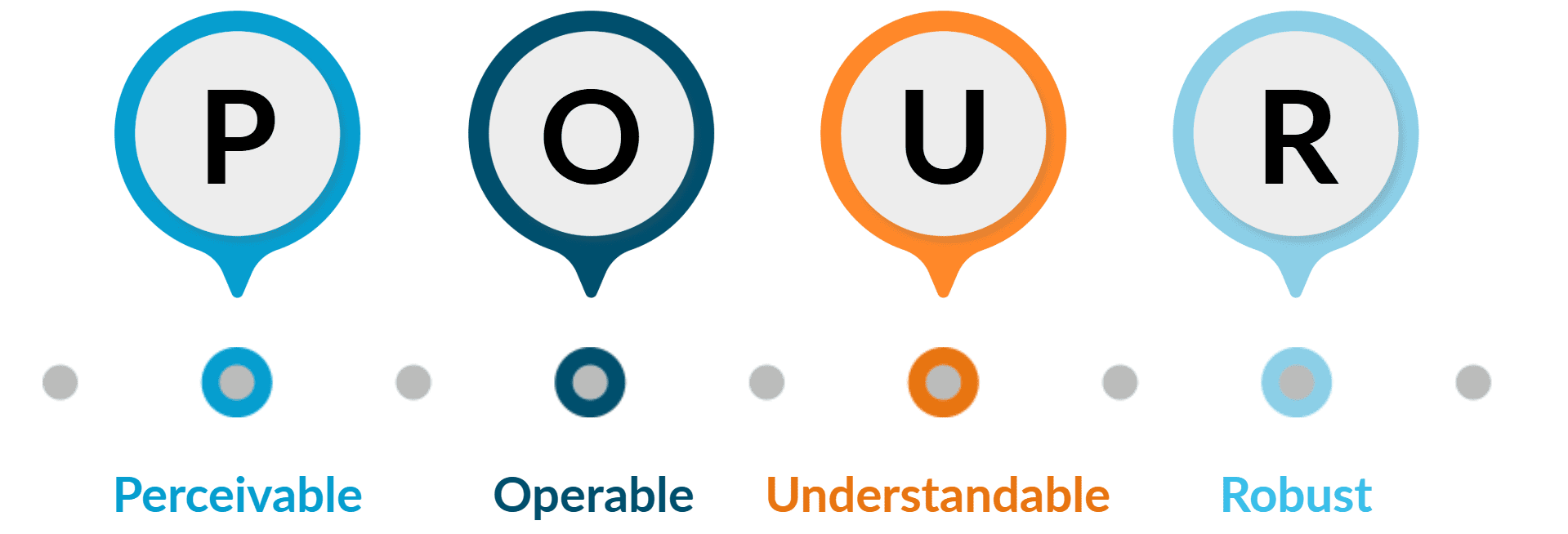
Accessibility is guided by the Web Content Accessibility Guidelines (WCAG). WCAG is an internationally-recognized standard that underpins legislation such as the Americans with Disabilities Act (ADA) and the European Accessibility Act (EAA). The guidelines use four foundational principles – that experiences are Perceivable, Operable, Understandable, and Robust.
Perceivable
Perceivable design ensures that information is presented to users in ways they can perceive it. For example, visual content has text alternatives, multimedia uses captions and transcripts, and color palettes use sufficient contrast to distinguish elements. A perceivable interface supports the different sensory needs of users and associated assistive technologies.
Operable
Operable, digital interfaces recognize that different users may use different technologies for navigation and input. Users who are limited in their use of pointing devices may require total availability of predictable interactions via their keyboard. Motor impairments may require larger targets for interaction or more time to achieve outcomes.
Understandable
Understandable content means information and operations must be comprehensible. Text should be legible, pages should behave predictably, and users should have the ability to receive help to avoid and correct mistakes. While this principle benefits users with cognitive disabilities or language barriers, it enhances experiences for everyone by decreasing confusion and cognitive load.
Robust
Robust content must work reliably across a wide variety of user agents, including assistive technologies. As technologies evolve, robust content remains accessible through screen readers, voice control systems, and future tools users will depend on.
Business Value of Accessible Design
Beyond ethical imperatives, accessible design produces measurable business value. Organizations that invest in accessibility routinely see gains in customer engagement, broader market reach, stronger brand trust, and reduced friction across user journeys. These improvements don’t just benefit people with disabilities – they enhance the overall user experience, leading to higher retention and improved financial performance.
Expanded Market Reach
Globally, people with disabilities represent a significant portion of the population and a substantial purchasing power. Approximately 16% of the world’s population experiences some form of disability. In the United States alone, people with disabilities control approximately $490 billion in disposable income annually.
This American Life, a weekly radio program, created transcripts for their entire archive in 2011 to comply with new FCC regulations. A study by their media partner found that transcripts increased search traffic by 6.86%. Over the course of more than a year, analytics data showed that 7.23% of visitors viewed at least one transcript. The transcripts also drove a 4.18% increase in unique visitors, while new, inbound links to transcripts accounted for a 3.89% increase in traffic.
Universal Design Benefits
Accessible design patterns frequently improve experiences for all users. Video captions, originally designed for deaf users, are used by 80% of viewers who watch videos with sound off in public spaces. Voice control interfaces developed for users with motor disabilities have become mainstream features that are now used by everyone while driving or multitasking.
When Apple introduced VoiceOver on iPhone in 2009, they demonstrated how accessibility features could be elegantly integrated into premium products. Today, features like Voice Control and AssistiveTouch are no longer hidden. They’re first-tier features leveraged by everyone.
Search Engine Ranking
Accessible websites often perform better technically and rank higher in search results. Clean, semantic HTML, proper heading structures, and descriptive link text, all accessibility best practices, are prioritized by search engines. Alternative text helps search engines interpret visual content, while transcripts offer additional text for indexing. Another benefit is that these same practices typically result in faster load times and better performance across devices.
The Legal Imperative: Real Consequences
Over the past five years, litigation related to digital accessibility has surged. In the U.S., Title III of the ADA prohibits discrimination in places of “public accommodation,” which courts interpret to include digital properties. Lawsuits related to digital accessibility exceeded 4,000 cases in 2024 alone.
Domino’s Pizza faced years of expensive litigation after a blind customer sued in 2016, claiming that their website and app weren’t accessible with screen readers. The Supreme Court declined to hear the case in 2019, allowing lower court rulings to stand. While we don’t have exact amounts on legal costs incurred, we can assume they far exceeded what proactive accessibility investments would have been.
Beyoncé’s Parkwood Entertainment had a similar experience in January 2019. A class-action lawsuit was filed alleging that the company’s website was not accessible to visually impaired users as it failed to include alternative text for images and properly label headings. The settlement amount was not disclosed but is believed to be in millions of dollars.
Courts increasingly reference WCAG 2.1 Level AA conformance as the technical standard for compliance. The EAA explicitly references WCAG standards and extends requirements across e-commerce, banking, telecommunications, and transportation services for EU member states. Companies operating in European markets are subject to mandatory compliance, with substantial penalties for violations. Settlement costs extend beyond legal fees to include remediation, third-party audits, and monitoring, among other expenses, often totaling millions of dollars.
Integrating Accessibility from Day One
The most successful accessibility implementations aren’t retrofits. Organizations that treat accessibility as an afterthought face higher costs, technical debt, and delayed releases.
Research and Design
Accessible products begin with inclusive research. Companies can recruit participants with disabilities, test with assistive technologies, and document accessibility needs as user stories. Design can treat accessibility guidelines as creative constraints that drive innovation. Design systems should integrate accessibility into every component from the outset.
Development and Testing
A key aspect of supporting accessibility is the use of Accessible Rich Internet Application (ARIA) tags – an extension to HTML properties that communicate greater context to assistive technologies. Through implementation of ARIA tags, use of semantic HTML elements that provide built-in accessibility features, and management of element focus to ensure optimal accessibility, developers can adhere to best practices for ground-up support of accessible design. Accessibility can then be verified continuously through automated testing in CI/CD pipelines, manual testing with assistive technologies, and regular expert audits.
Building Culture
Sustainable accessibility requires organizational commitment. Training team members and involving them in performance metrics are two crucial aspects. A key to success is ensuring your teams understand your goals and understand how well you’re reaching them.
Wrap Up
Advances in technology have made it possible for more people with disabilities to access digital products and services than ever before. Yet, true accessibility goes beyond simply providing access—it means designing experiences that are usable, intuitive, and empowering for everyone. The benefits of accessible design extend far beyond compliance, driving innovation, expanding market reach, and strengthening brand reputation. Organizations that embrace accessibility from the start position themselves for long-term success, while those who delay face higher implementation costs, missed opportunities, and risk of bad publicity, legal action, and regulatory fines.
Whether you’re retrofitting existing properties or building new digital solutions, integrating accessibility into your product development process is crucial for achieving sustainable growth and fostering customer loyalty. Explore how accessible design delivers real results in our Shop Without Limits: Ecommerce Accessibility Case Study.
Insights By

Make your digital experiences accessible to all
Contact AIM Consulting today to schedule an Accessibility Audit or learn how our experts can help you embed accessibility into every stage of your product development journey.
Let’s work together to create inclusive, innovative solutions that benefit your business and your customers.