


Why Organizational Change Management Is Foundational to Enterprise Agility
Agile transformations rarely fail because teams misunderstand frameworks. They fail because organizations underestimate the scale, depth, and durability of the behavioral and cultural change required to make Agile actually work.
Across industries, teams encounter the same symptoms: ceremonies feel like overhead, delivery still slips, leaders default to old habits, and engineers wonder, “If I’m in all these meetings, when am I supposed to do the work?” These aren’t signs of resistance — they’re signs that change has not been meaningfully managed.
This is why Organizational Change Management (OCM) is the backbone of real agility. It ensures people understand why change is happening, how it affects them, and what shifts in behavior, decision‑making, and leadership are required to sustain it over time.
Without OCM, Agile becomes ritual. With OCM, Agile becomes capability.
What OCM Actually Is (and Is Not)
OCM is often lumped in with communications, training, or stakeholder updates. Those are components — not the work itself.
OCM is the structured, ongoing practice of enabling people and leaders to adopt new ways of working, consistently and at scale.
In Agile transformations, OCM focuses on:
- Helping teams understand what is changing and how their daily work will look different
- Coaching leaders on simple, practical behaviors that support Agile ways of working
- Anticipating resistance and addressing it by design
- Reinforcing new norms until they become “how we work”
OCM is durable work because Agile isn’t a one‑time implementation. It requires ongoing reinforcement as teams mature, leaders shift, and business priorities evolve.
Why Agile Transformations Fail Without OCM
Most organizations adopt Agile with the right intent: improving predictability, reducing chaos, increasing quality, and building healthier team environments. But when OCM is absent, a predictable failure pattern emerges:
- Leaders reinforce visible mechanics instead of behavioral shifts
- Messaging focuses on compliance rather than outcomes
- Teams view Agile as overhead and more meetings they have to attend
- Meetings increase before value appears
- Engineers quietly revert to old habits
- Delivery expectations remain rooted in waterfall thinking
- Roles become unclear, creating friction and slowdown
These are not signs of dysfunction — they’re predictable consequences of change that hasn’t been supported.
Messaging and Leadership Behavior Matter More Than Mechanics
Agile fundamentally shifts how organizations prioritize work, make decisions, interact with teams, and measure success. These shifts cannot be mandated; they must be understood, reinforced, and modeled.
OCM ensures that:
- Leaders articulate why Agile exists before enforcing how it works
- Engineers understand how ceremonies protect focus rather than consume it
- Teams see how Agile reduces rework, elevates quality, and prevents late‑stage chaos
- Leadership behaviors evolve — not just team expectations
When leaders revert to old behaviors (e.g., inflexible upfront commitments, bypassing sprint boundaries, or prioritizing output over outcomes), trust erodes and Agile loses purpose.
OCM as the Engine of Durable Transformation
Agile adoption evolves over time. Teams mature. New leaders join. Market pressures change. Without durable reinforcement, organizations quickly regress to old habits — especially under pressure.
OCM provides the mechanisms to sustain agility:
- Reinforcing desired behaviors through leadership routines
- Continuously refining messaging as teams progress
- Identifying friction early and addressing it systemically
- Protecting teams from reverting to legacy patterns
- Ensuring teams experience Agile as empowerment, not overhead
This ongoing reinforcement is the difference between organizations that do Agile and those that operate with agility.
How OCM Integrates Into the Agile Cadence
OCM is most effective when embedded directly into the Agile rhythm — not layered on the side:
- Standups → Pulse checks on change friction
- Sprint Reviews → Reinforce value creation and user‑centered outcomes
- Retrospectives → Safe spaces to identify resistance and refine behaviors
- Planning & Backlog Refinement → Model prioritization and tradeoff conversations
When tightly integrated, OCM turns Agile ceremonies into catalysts for adoption rather than hurdles.
Our OCM‑Enabled Agile Transformation Approach
AIM’s Organizational Change Management approach is intentionally designed to be embedded throughout the Agile journey — not treated as an add‑on or final step.
Core Components
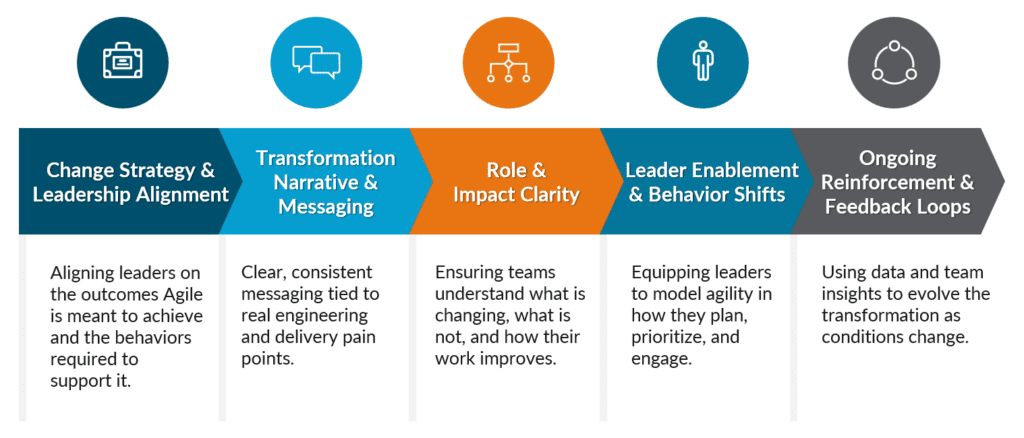
Top 5 Takeaways
- Agile success is less about ceremonies and more about sustained behavior change.
- OCM is essential for adoption, not an optional support function.
- Leadership alignment and modeling are the highest‑leverage enablers of Agile.
- Without OCM, Agile devolves into activity instead of value.
- With OCM, Agile transformations achieve predictability, quality, and team empowerment.
Bottom Line
Agile is a system change, not a process rollout.
OCM is what makes that change stick — by aligning leadership, messaging, behaviors, and team experience over time.
Without OCM, Agile produces activity.
With OCM, Agile produces outcomes.
Insights By

Frequently Asked Questions
Organizational Change Management (OCM) is critical because it addresses the human element of transformation, which is the primary driver of project success or failure. While Agile focuses on technical processes and frameworks, OCM manages the cultural shift, minimizes employee resistance, and ensures that the new ways of working are adopted and sustained across the organization.
Agile transformations most commonly fail due to cultural resistance and a lack of leadership alignment rather than technical or process issues. Without a dedicated change management strategy, organizations often implement “Agile in name only,” where teams follow ceremonies but maintain a legacy mindset, leading to stalled productivity and a lack of long-term ROI.
Leadership impacts Agile success by serving as the primary architects of the organizational culture and the ultimate models for new behaviors. For a transformation to take hold, executives must move beyond mandating process changes and instead actively demonstrate Agile principles, such as transparency, empowered decision-making, and iterative learning.
“Doing Agile” refers to the adoption of specific tools and ceremonies like Scrums and Sprints, whereas “Being Agile” represents a fundamental shift in mindset and organizational culture. “Being Agile” focuses on values like customer-centricity and continuous improvement, which are necessary to sustain the benefits of the framework long after the initial implementation phase.
Integrating OCM with Agile improves ROI by accelerating the “speed of adoption” and increasing the “ultimate utilization” of new processes. By proactively managing the transition for employees, organizations reduce the productivity dip typically associated with large-scale change, ensuring that the financial benefits of Agile—such as faster time-to-market—are realized sooner.
The key steps to integrating OCM into Agile include aligning leadership on the “Why,” identifying cultural blockers early, and embedding change practitioners directly into Agile squads. This integrated approach ensures that communication and training are delivered iteratively (in “sprints”) rather than as a single, overwhelming event at the end of the project.